



Beginner to Advance · 54 Days · Rishikesh
500 Hour Yoga Teacher Training in Rishikesh, India
Master Yoga at Its Birthplace with a Yoga Alliance Certified School
$2,649≈€2,499≈£2,199≈A$4,199≈C$3,799≈₹2,38,499all inclusive
- Days of training
- 54Days of training
- Daily classes
- 9 hrsDaily classes
- Teachers
- 8Teachers
- Max batch size
- 15 to 18Max batch size
500 Hour Yoga Teacher Training in Rishikesh, India
54 days residential · Beginner to Advance
$2,649≈€2,499≈£2,199≈A$4,199≈C$3,799≈₹2,38,499
- Duration
- 54 Days, in two 27-day blocks
- Runs
- 2nd to 28th, monthly, per block
- Daily classes
- 9 Hours
- Teachers
- 8, MA / PhD in Yoga Science
- Batch size
- 15 to 18
- Language
- English
- Module
- Residential
- Level
- Beginner to Advance
- Prerequisite
- None. It contains the 200 hour
- Certification
- Yoga Alliance, RYS 500
- Free airport pick-up (DED)
- 54 days accommodation
- 9 hours daily classes
- 3 daily nutritious meals
- Small batch, 15 max
- Yoga Alliance certificate
- Study materials
- Free yoga equipment
- Yoga kitbag
- Classes at Ganga beach
- Private washroom
- Naturally ventilated rooms
- Free WiFi
- Fire ceremony
- Himalayan excursion
- Ganga Aarti
- Cultural program
The whole pathway in one decision: 200 hours to qualify, 300 more to go deep, and a fee that is exactly the two added together.
Our 500 Hour Yoga Teacher Training in Rishikesh, India is the full pathway in one booking: the 200 hour and the 300 hour taken together, 54 days of training in total, at $2,649≈€2,499≈£2,199≈A$4,199≈C$3,799≈₹2,38,499 per person for a shared room and $3,149≈€2,999≈£2,599≈A$4,899≈C$4,399≈₹2,83,499 for a private one. The school is registered with Yoga Alliance at RYS 500, and 500 hours is the level Yoga Alliance registers a teacher at.
A residential training with nine-hour days across the full subject list, taught by eight teachers holding an MA or a PhD in Yoga Science. Traditional practice and contemporary teaching method, from your first sun salutation through to leading a class of your own under correction.
Nothing about the training is compressed to fit the booking. The 200 hour block is the 200 hour course and the 300 hour block is the 300 hour course — the same teachers, the same syllabus and the same daily timetable as the students who booked them one at a time. What the single booking changes is the fee, the paperwork, and the fact that you never have to plan the second trip.
What the training actually looks like
Photographs from our own hall and campus in Rishikesh — not stock pictures. Swipe through, and tap any one to see it larger.
Your Certificate
What you leave with
Not a PDF and a handshake. A numbered, verifiable certificate that a studio on the other side of the world can check against our records while you are still sitting in the interview.
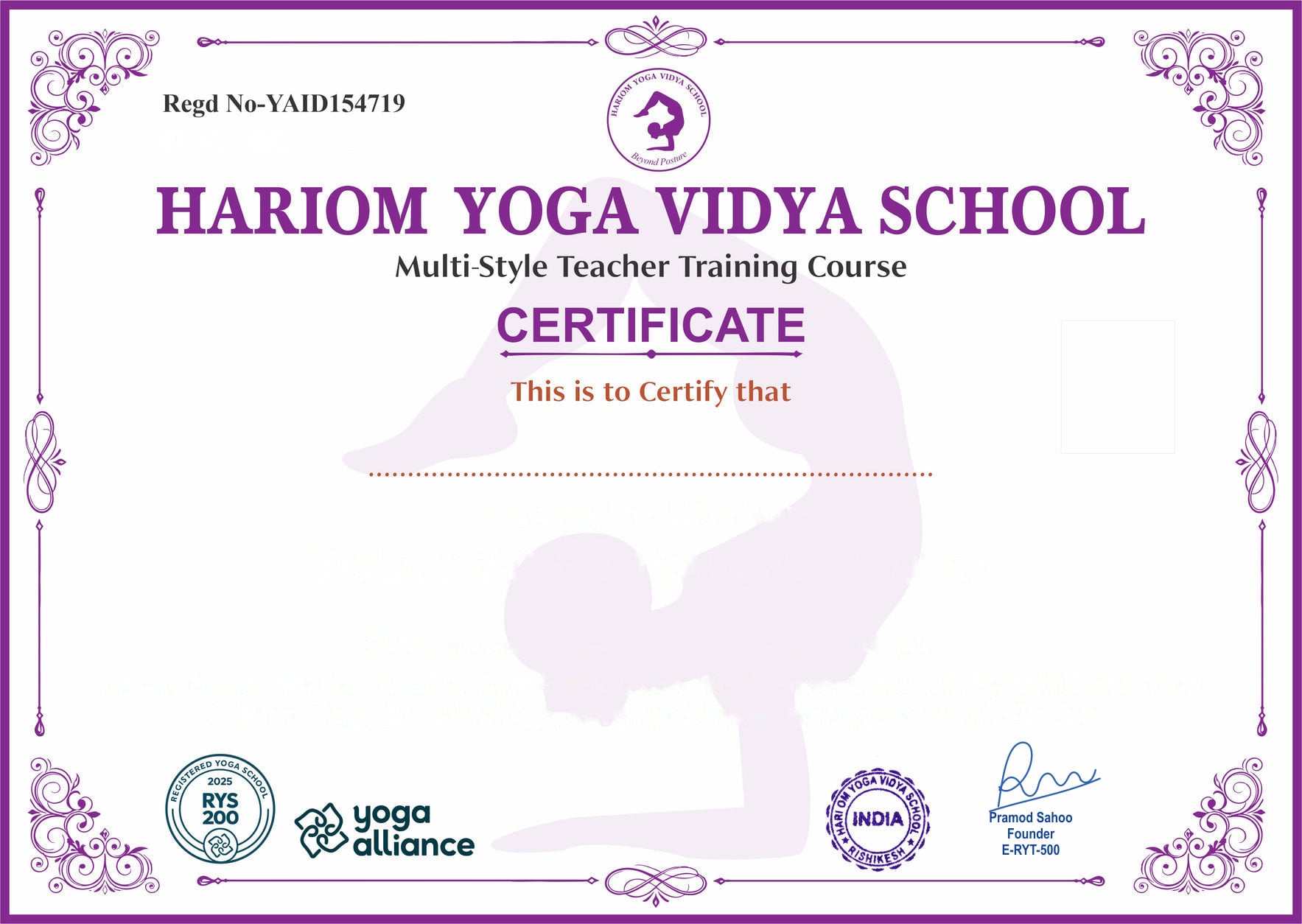
 Cert No-HYVS-200-2026-K7Q4MANJANA KUMARhas successfully completed the 500 hourYOGA TEACHER TRAININGcompleted on 28th March 2026, as perthe guidelines and standards of Yoga Alliance, USA, which involved extensive practice and study of Hatha Yoga, Kundalini Yoga, Ashtanga Vinyasa, Pranayama and Meditation.SCAN TO VERIFY
The school's own certificate, shown with a specimen name, number and signature — that number matches no record, the code on it opens this page rather than anyone's, and the signature is a stand-in. Yours carries your name, your photograph, your batch dates, a number that is yours alone, and the founder's own signature.
What is on the face of it
Six things are printed on every certificate this school issues, and each of them is there so that somebody who has never heard of us can still act on it.
- 01
The Yoga Alliance seal
Bottom left, beside the Yoga Alliance mark itself: the seal of a Registered Yoga School. Hariom Yoga Vidya School holds RYS 200, RYS 300 and RYS 500, and each certificate carries the seal for the level its training was run at.
- 02
Registration number YAID154719
Printed top left, on every certificate the school has ever issued. It is the school's own Yoga Alliance registration, and it can be looked up in the Yoga Alliance directory by anybody who wants to check us rather than the certificate.
- 03
A certificate number that is yours
Directly beneath it, in the form HYVS-200-2026-K7Q4M. The hours, the year and five characters drawn at random — thirty-three million possibilities per course, per year, so nobody guesses their way to a valid one.
- 04
A QR code that says SCAN TO VERIFY
Along the foot of the certificate. A phone camera opens our verification page for that exact certificate — no app, no typing, and no need to contact the school at all.
- 05
Your photograph, and the founder's signature
The portrait sits in the frame on the right and is printed into the document rather than stuck on afterwards. The signature is that of the school's founder, Yogi Pramod Sahoo, E-RYT 500, beside the school's Rishikesh seal.
- 06
Printed, not emailed as a template
Every certificate is generated from the school's own artwork with the type set into it, so the document a graduate is handed and the record in our register are made in the same moment, from the same data.
Two ways to check one
Scan the QR code
Point a phone camera at the code on the foot of the certificate. It opens the record for that certificate directly — nothing to type.
Or type the certificate number
Go to /verify-certificate and enter the number printed under the registration number, top left. Same record, same answer, and it works from a photocopy or a number read out over the phone.
Scan it, and it checks out
Every certificate carries a QR code pointing at our own records. A studio, retreat center or insurer can confirm in seconds that we issued it, for that course, on that date — without emailing us and waiting three days for a reply.
A number that is yours alone
The certificate number is unique to you and printed on the face of the certificate, top left, directly under the school's Yoga Alliance registration number. Nobody can guess it: the last five characters are drawn at random from an alphabet that makes thirty-three million codes per course, per year. It is the only thing anyone needs in order to check your training.
Registered with Yoga Alliance
Hariom Yoga Vidya School is a Yoga Alliance Registered Yoga School at RYS 200, RYS 300 and RYS 500. Graduates of the 200 and 300 hour trainings can register directly as RYT 200 and RYT 500 teachers worldwide.
Why Hariom
Why Train for Your 500 Hour in Rishikesh
What students tell us made the difference.
Learn from Experienced Yoga Teachers in Rishikesh
Eight teachers, each holding an MA or a PhD in Yoga Science, and the same eight across both halves of the training rather than a second faculty for the advanced block.
Train in a Serene Himalayan Location
Our school is in Tapovan, above the Ganga, in the town yoga is taught from. Two months there is long enough to stop being a visitor.
One Syllabus, Taught the Whole Way Through
Every subject is picked up in the 200 hour block and taken further in the 300 — the same teacher, carrying on. Nothing is introduced twice and nothing is assumed to have been covered somewhere else.
The Full Yoga Alliance Pathway in One Booking
500 hours is the level Yoga Alliance registers a teacher at, and this is the whole of it: no second application, no second flight, and no gap in which the first half goes cold.
The Fee Is Exactly the Two Courses Added Up
Booking the pathway as one training costs no more than booking the 200 hour and the 300 hour separately, at both room rates. You are not paying for the convenience.
Open to Beginners, Because It Starts at the Beginning
There is no prerequisite. The 500 hour contains the 200, so a reader with no training at all can book the entire pathway and arrive on day one of it.
Curriculum
The Full 500 Hour Syllabus
14 subjects across the full 500-hour syllabus — open any to see what it covers.
Hatha Yoga
The spine of both blocks and the first class of every day. The 200 hour teaches you the postures; the 300 hour takes them apart.
The subject you will spend the most hours of your life in, and on this course you get roughly a hundred of them. The arc is the point: in the first block a posture is a name, a history, a set of contraindications and six meditative steps in and out of it, and by the second it is a thing you are taking apart anatomically and putting back together for somebody whose hips do not do what yours do. Fifty-four days is long enough that the postures you struggled with in week one come back around, twice.
- First block: name in English and Sanskrit, history, benefits and contraindications, six meditative steps in and out, and the counter-pose
- First block: joints and glands, then standing, sitting, bending and twisting, the fire series, inversions, Surya and Chandra Namaskara
- Second block: the anatomical and therapeutic aspect of each posture, and the corrections and modifications a real class needs
- Second block: advanced asana, and holding a posture long enough for the breath rather than the shape to be the work
Ashtanga Vinyasa
The dynamic half of the timetable, taught late in the afternoon. This is the subject where the two blocks are furthest apart: the primary series first, the intermediate series second.
The strand where the two halves are furthest apart, and the clearest reason to take them together. The first block builds the primary series a section at a time — sun salutations, standing, sitting, finishing — until ujjayi, bandha and drishti stop being vocabulary. The second block starts where that ends: Kapotasana, Bhekasana, Krounchasana, Ekapada and Dwipada Sirsasana, the advanced arm balances and inversions, with tristhana holding all of it together. Taken separately there is usually a year in that gap. Taken here there is a weekend.
- First block: sun salutation A and B, then the standing, sitting and finishing series, built up a series at a time
- First block: ujjayi breath, bandha in Ashtanga, and drishti — vocabulary turned into something you do
- Second block: the intermediate series — Kapotasana, Bhekasana, Krounchasana, Ekapada and Dwipada Sirsasana
- Second block: advanced arm balances and inversions, with tristhana holding asana, breath, bandha and drishti together
Kundalini Yoga
An hour of its own on both timetables, and the strand this school is known for. Reconstructed from the beginning in the first block, then given a full afternoon slot as Kundalini and Tantra Yoga in the second.
This school's specialization, and the one subject that gets more rather than deeper in the second block: an hour every mid-morning in the 200 hour classes, then a full afternoon slot of its own as Kundalini and Tantra Yoga in the 300. Kundalini works through mantra, repetition and kriya rather than through shape — waking the energy held dormant at the Muladhara and following it up through each chakra and nadi it passes. Taught from the history and the methods of awakening onward, and always with the contraindications that belong to it.
- First block: history, styles, and the methods of awakening; kriya yoga and the role of prana
- First block: nadis, chakras, granthis and kshetras — all seven chakras, Muladhara through Sahasrara
- Second block: Kundalini and Tantra Yoga daily, working through mantra, then physical practice, then kriya
- Second block: every technique taught with its contraindications, closing on relaxation, meditation and affirmation
Pranayama
Prana is the vital energy of the body, yama its expansion. Eight techniques in the first block, taught with meaning, benefits, contraindications and duration; the advanced variations of them in the second.
- First block: Kapalabhati, Sheetali and Sheetkari, Bhastrika, Bhramri and Ujjayi
- First block: Nadishodhana, channel purification, technique one
- Second block: Nadishodhana techniques two and three, and the ratios that go with them
- Second block: pranayama held with bandha, and the practices that are not taught to a first-year student
Satkarma
Six purification techniques — Basti, Nauli, Dhauti, Trataka, Neti and Kapalbhati — each targeting particular organs, balancing the tridoshas and freeing the flow of prana. Demonstrated to you first, then led by you.
- First block: all six introduced with benefits and contraindications
- First block: Jala Neti and Sutra Neti — preparation, demonstration, technique, practice
- Second block: the remaining kriyas practiced rather than watched
- Second block: you prepare and lead the satkarma class yourself while a teacher watches
Bandhas
A bandha is a lock — a muscular contraction that holds and redirects energy toward particular organs, raising blood flow and prana with it. Four in the first block, and the advanced applications in the second.
- First block: Jalandhara Bandha, the thyroid, parathyroid and respiratory organs
- First block: Uddiyana Bandha and Mula Bandha, the latter especially used to awaken Kundalini energy
- First block: Maha Bandha, the three together and the highest form of body lock
- Second block: bandha inside pranayama and inside Ashtanga practice, rather than as an exercise of its own
Mudra - Gesture
Gestures that channel prana. In Ayurveda each finger carries one of the five mahabhutas — fire, earth, air, water, ether — so a gesture can raise or lower the flow to a given part of you. Four in the first block, eight by the end of the second.
- First block: Jnana Mudra, the psychic gesture of knowledge
- First block: Chin Mudra, Bhairava (Shiva) Mudra and Hridaya Mudra
- Second block: four more, with the conditions each is used for
- Second block: mudra held through a full pranayama or meditation sitting rather than demonstrated
Meditation
Not one technique but a dozen, so you leave with a practice that suits you rather than the one you were handed. Props included: singing bowls, malas, music.
- First block: mantra chanting, Ajapa and OM meditation; Trataka on dot, yantra and candle
- First block: walking, dancing and music meditation, and the sixty-one energy points
- Second block: Osho dynamic meditation and the longer sittings
- Second block: teaching a meditation rather than sitting one — pace, voice, and what to say when nothing is happening
Yogic Relaxation Techniques
Conscious relaxation taught as a discipline in its own right: instant and quick techniques, Shavasana as guided practice, and Yoga Nidra for the deep states.
- First block: point-to-point movement, then stillness
- First block: whole-body and selective tension and release
- First block: spinal breathing with So-Ham, and visualization at the cardiac center
- Second block: Yoga Nidra led by you, which is harder than it sounds and is where most students find their voice
Alignment, Correction & Adjustment
Alignment is the precise placement of feet, legs, pelvis, spine, arms and head so energy moves freely and joints stay safe. Adjustment is how you help someone else find it, with sensitivity and consent.
- First block: the components of alignment — spine, joints, muscles
- First block: physical adjustment against verbal adjustment, and the limits of hands-on work
- Second block: anatomy and alignment as a subject in its own morning slot
- Second block: adjusting a room of strangers rather than a classmate who knows what is coming
Teaching Methodology
"Teaching is an art and it can be developed through practice and knowledge." The principles in the first block; standing in front of people in the second.
- First block: welcome the students, start and end on time, ask about injuries first
- First block: clear instruction, audible voice, equal attention with extra for beginners
- Second block: sequencing a class, and sequencing a course
- Second block: teaching practice under correction, which is the reason this block exists
Yoga Philosophy
The blueprint under the practice: mind, body and soul as one thing, and the framework that says which parts of the practice you cannot leave out.
- First block: the Yoga Sutra — discipline, types of thought, God
- First block: seven chakras; three gunas; three bodies; the eight limbs
- Second block: obstacles to yoga and causes of pain, taken at length
- Second block: philosophy as something you can teach, with an exam at the end of it
Mantra Chanting
"Manas" means mind and "tra" means instrument or freedom from — so mantra literally means a tool the mind uses to free itself from its own distractions. No musical background is needed.
- The Hatha Yoga opening chant, Yogena Chittasya; Aum and the Gayatri mantra
- Ganesh mantra, Guru mantra, and the Ashtanga opening and closing mantras
- Recited as mantra or set to a melody — everyone joins in at once
Fire & Flower Ceremonies
The havan that opens the course, and the flower mandala laid out for it — marigolds on the grass, the tilak, and the batch sitting round the kund making offerings into the fire.
- The havan that opens the course, and what is offered into it
- Laying the Om and the mandala in flower petals
- For most students the first fire ceremony they have sat at
Board & Lodging
Food and Accommodation During the Course
Both are part of the fee. Neither is an afterthought.

Food as Medicine
Sattvic Vegetarian Meals
Our yoga school serves three nourishing vegetarian meals daily, prepared with fresh, locally-sourced ingredients.
These Sattvic meals support your yoga practice by promoting health and clarity through a balanced diet of vegetables, grains, fruits, and herbal teas.
Where You'll Stay
Cleanliness Standards
Rooms are looked after throughout your stay, with special care given to bedding, bathrooms, and common areas.
Fresh linens, sanitized surfaces, and well-ventilated spaces ensure that you feel safe, comfortable, and cared for during your stay.
Private · Double-sharing · Triple-sharing
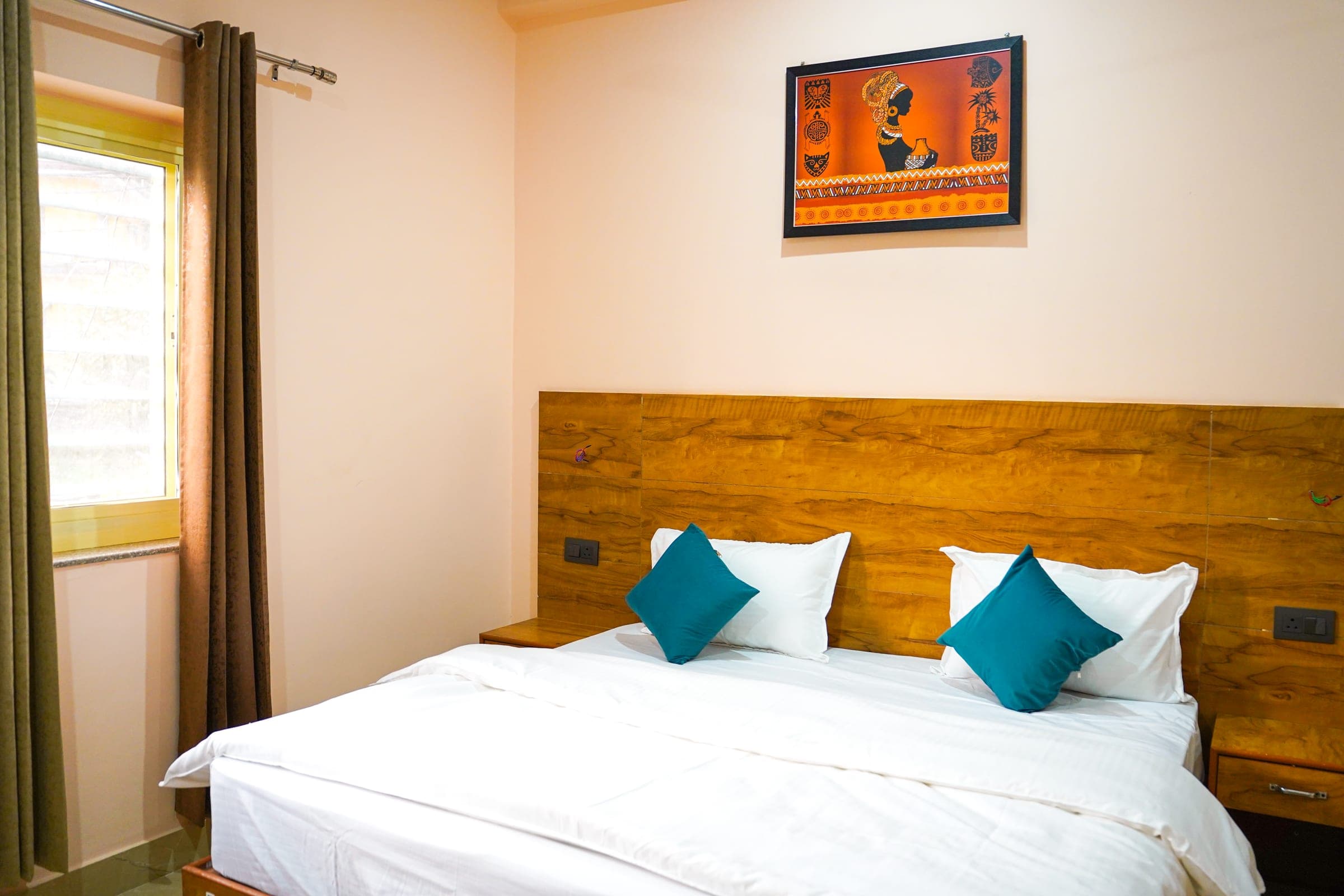
Wi-Fi, hot water and mountain views throughout — see the rooms in full.
Outcomes
What you leave with
Beyond the 54 days themselves.
Eligible to Register at RYT 500
The 500 training hours Yoga Alliance asks for, from a school registered at RYS 200, RYS 300 and RYS 500. Registration itself is a voluntary application you make once you graduate.
A Qualification to Teach Anywhere
RYT 500 is the credential studios recognize across North America, Europe, the United Kingdom and Australia — for teaching, for running workshops and retreats, or for opening a school of your own.
Two Months of Continuous Practice
The single largest thing this booking buys is time. A subject introduced in week two is still being taught in week seven, which is long enough for a practice to become yours rather than something you were shown.
Teaching Practice Under Correction
The 300 hour block puts you in front of the class: you prepare and lead sessions, including the satkarma class, while a teacher watches and corrects. That is the half a 200 hour on its own cannot give you.
Connect with a Global Yoga Community
You overlap with several intakes across two months rather than one, so the network you leave with is wider than a single batch — and the school stays in touch with its graduates.
Personal Growth and Self-Transformation
Meditation, philosophy, pranayama and satkarma taken over 500 hours rather than 200 is a different experience of the same syllabus, and most students say so about the second block rather than the first.
Student Voices
From our students
Reviews our students left on Google, across every program.
Rated 4.9 Stars by 3000+ Students
4.9 out of 5 · 3,000+ students
Swapna Kukkala rated us 5 out of 5
“I had a wonderful learning experience here and truly enjoyed the course. The structure was very well designed and thoughtfully organized.”
Lisa Lmar rated us 5 out of 5
“Incredible & Life changing experience, The Best Authentic and Traditional Yoga School in Rishikesh, India”
Jharna Chandra rated us 5 out of 5
“I loved the experience here. Our professors were amazing! We learned so much in such a short time. The staff, the food everything was amazing!!”
shay vaknin rated us 5 out of 5
“Wonderful place, wonderful people, I did a 6-day yoga retreat and it was amazing with a very personal approach”
Darshita Tiwari rated us 5 out of 5
“Thank you for this memorable experience. It has transformed us in ways unimaginable. Not just the school premises, but teachers, class mates, Kitchen staff, all had so much knowledge for each and every one of us. Have learned layers and layers of information + knowledge. Thankfully food, rooms were all top notch and well taken care of so we could fully focus on learning alone.”
4.8 out of 5 from 192+ reviews on Google
Fees
What the 500 Hour Costs, and What Is Included
One figure, quoted per person in US dollars. Everything the course needs is inside it.
The 500 Hour Yoga Teacher Training costs $2,649≈€2,499≈£2,199≈A$4,199≈C$3,799≈₹2,38,499 per person for a shared room, or $3,149≈€2,999≈£2,599≈A$4,899≈C$4,399≈₹2,83,499 for a private one. It is an all inclusive fee across the whole of the training, and the list of what it covers is not a short one: every class in both blocks, your room, three vegetarian meals a day, study material, a yoga kit that is yours to keep, the Himalayan excursion, the fire ceremony, the Ganga Aarti, your certificate, and a free pick-up from Dehradun airport.
That figure covers the 200 hour and the 300 hour together, at both room rates. Booking the pathway as one training costs no more than booking the two courses one at a time — you are not paying a premium for the convenience, and you are not being asked to commit early for a discount. It is the same 500 hours either way.
A deposit holds your seat and the balance is due when you arrive. Because the two blocks are scheduled with you rather than picked off a table, write to us before you book flights — the section below says why, and what we need from you.
How payment works — deposit, bank transfer and what happens if your plans change.
What the fee does not cover
- Your flights, and your visa.
- Personal expenses, and any extra activities you choose in Rishikesh.
- Travel to Rishikesh from anywhere other than Dehradun airport. A cab from Delhi airport can be arranged and is charged separately — ask us for the current price before you book it.
- Air conditioning and a heater. Neither is in the standard package; both can be arranged at an extra cost.
Included, No Extra Charge
What comes with it
Nothing here is an add-on you pay for later.
Free classes & cultural activities
- Ganga Aarti
- Himalayan excursion
- Hatha Yoga workshop
- Hypertension class
- Prenatal yoga class
Yours to keep
- Study material
- T-shirt
- School handbag
- Notebook & pen
- Yoga books
- Japa mala
- Yoga pant
Yours to use — provided free, and left behind
- Yoga mat
- Bolster
- Bricks
- Cushion
- Zen bench
- Yoga chair
- Yoga belt
- Neti pot
Dates & Fees
Batch Dates, and How the Two Blocks Are Scheduled
A batch starts every month, capped at 15 to 18 students.
A batch starts on the 2nd of every month, and each of the two blocks runs 27 days. How they sit relative to each other is arranged with you.
That is the one thing about this course we will not put in a table. Some students take the two blocks back to back and are here for the whole of it; others take the 200 hour, go home and teach for a season, and come back for the 300. Both are the same course at the same fee, and which one is right depends on your leave, your visa and how much time you want between qualifying and going deeper.
So write to us before you book anything. Tell us roughly when you can come and how long you have, and we will tell you which intakes your two blocks fall in and give you the exact arrival and departure dates for each. Nothing about the fee changes either way, and your seat is held with a deposit once the dates are agreed.
One date is fixed whichever route you take: a block begins on the 2nd of the month and teaching starts on the morning of the 3rd. Your room and your meals are covered from your arrival day.
The fee covers every class, accommodation, three meals a day, study materials, the certificate and course activities. Air conditioning and heating are available on request — tell us what you need when you enquire and we'll confirm availability for your dates.
Who the 500 Hour Is For
- No prior training required — this course contains the 200 hour
- Age limit – Above 16 years
- No teaching experience needed. Building it is what the second block is for
- Already hold a 200 hour from a Yoga Alliance registered school? Book the 300 hour instead — it is the half you are missing, at half the fee
What RYT 500 Means
- The school is registered with Yoga Alliance at RYS 200, RYS 300 and RYS 500. Graduates of this course hold the 500 training hours Yoga Alliance asks for and can apply to register as an RYT 500.
- Yoga Alliance also asks for teaching experience logged after your 200 hours before it will register anyone at RYT 500. That requirement is theirs to define and it changes — check the current version on their own site while you plan. The hours we certify are the training half of it.
- Your certificate is verifiable: a studio anywhere can scan the QR code on it and confirm we issued it, for this course, on those dates.
The pathway
200 + 300: How the Pathway Works
A 200 hour and a 300 hour add up to 500, and 500 is the level Yoga Alliance registers a teacher at. This course is both halves.
Yoga Alliance registers schools at RYS 200, RYS 300 and RYS 500, and registers teachers at RYT 200 and RYT 500. There is no such credential as an RYT 300, which surprises most people who go looking for one — so a 300 hour training on its own is the second half of a qualification rather than a qualification of its own. Booking the 500 hour is booking both halves at once, and it is the only way to arrive here with no training and leave with the full pathway behind you.
The first block is the 200 hour course, unchanged: the foundation qualification, open to beginners, and the certificate a studio asks to see. The second block is the 300 hour course, unchanged: the intermediate Ashtanga series, pranayama in techniques two and three, and teaching practice in front of a real class under correction. You are not in a separate 500 hour cohort — you are in the 200 hour classes and then in the 300 hour classes, with the students who booked them one at a time.
The shape of the day does not change between the two blocks, and that is deliberate — what changes is the level of what fills it. You practice Hatha in the morning and Ashtanga Vinyasa before dinner in both. In the second block the morning becomes the secondary series and starts half an hour earlier, at six, and the evening Ashtanga is the advanced one. Everything between them holds either way: Yin at half past nine, Kundalini and Tantra at half past ten, the pranayama and meditation block until one, philosophy and anatomy through the afternoon, assignments after dinner and silence from nine.
One thing the pathway asks of you that we cannot certify: Yoga Alliance wants teaching experience logged after your 200 hours before it will register anyone at RYT 500. That requirement is theirs and it changes, so check the current version on their site while you are planning. What we can tell you is that the training half of it is finished the day you leave.
For international students
Coming to Rishikesh from Abroad
What to settle before you book a flight, and what the certificate is worth when you get home.
The visa you need — ask us first
For a single block of 27 days the answer is a tourist visa, applied for online before you travel, and a tourist e-visa covers a stay of up to 60 days. This is the one course on which that ceiling is worth doing arithmetic against: 54 days of training is close to it, and whether your two blocks run back to back or across two trips changes the answer completely. So agree your dates with us before you apply for anything, and confirm the current rules with your own embassy — we are not immigration advisors, and there is no visa on arrival to fall back on.
Getting here, and getting back
Jolly Grant (DED) in Dehradun is the nearest airport, and most students reach it on a short domestic flight out of New Delhi. Your pick-up from DED is free, already inside the fee, and arranged around your flight rather than around a timetable. By road from Delhi it is 5 to 6 hours; Haridwar railway station is 45 minutes from the school. If you are taking the two blocks as two trips, the pick-up covers both arrivals.
What the certificate is, at home
500 hours is the level Yoga Alliance registers a teacher at, and RYT 500 is the credential studios recognize across North America, Europe, the United Kingdom and Australia — for teaching, for running your own workshops and retreats, or for opening a school. Registering is a voluntary application you make yourself once you graduate, and Yoga Alliance asks for teaching experience logged after your 200 hours as well as the training hours. Your certificate is verifiable from anywhere: a studio can scan the QR code on it and confirm we issued it.
When to come
A block starts on the 2nd of every month, so the question on this course is which two months rather than which one. October to February is the cool season and January is the coldest month of it. March to June is summer, reaching 35 degrees in June. July to September is the monsoon — warm, humid, and the greenest the valley gets. Two blocks back to back will cross a season, which most students find is a feature.
We are not immigration advisors. Confirm the current rules with your own embassy or consulate before you pay for anything.
Code of Conduct
What we ask of you
To cultivate a respectful and focused atmosphere, we kindly ask students to adhere to the following:
- Practice DisciplineArrive on time for classes, be respectful to teachers, and adhere to all rules.
- Respectful EnvironmentTreat all classmates and instructors with courtesy, regardless of background or beliefs. Refrain from harassment or discrimination of any kind.
- Disruptive ActivitiesAbstain from loud noises, use of electronics at high volume, or any behavior that disrupts the class.
- Cleanliness and SafetyRefrain from smoking, consuming alcohol or drugs, or using strong fragrances that might bother others. Maintain a clean and safe environment by putting away personal belongings after class.
- Food and DrinkRefrain from eating inside the classroom. Water is encouraged for hydration.
- Dress CodeWear comfortable clothing that allows for free movement while respecting a modest dress code.
- Healthy ParticipationListen to your body's limitations and communicate any injuries or concerns to the instructor before class.
- Respect the Yogic LifestyleMaintain a clean and safe space by avoiding smoking, alcohol, non-vegetarian food (including eggs), and strong fragrances.
- Be ConsiderateInform the kitchen manager of any dietary needs, fasting days, or planned outings to avoid food waste.
- Be ResponsibleReturn borrowed materials promptly.
- Attend RegularlyComplete attendance is expected for all scheduled programs.
- AccommodationProvided only for enrolled students, not guests or family.
The full text lives in our terms & conditions.
Questions
Questions About the 500 Hour Training
The things people ask us most about this course.
How long does the 500 hour training take altogether?+
54 days of training — the 200 hour block and the 300 hour block, 27 days each. Whether that is one stay or two trips is arranged with you rather than fixed in a calendar, because both are common and the right answer depends on your leave and your visa. A block starts on the 2nd of every month and teaching starts on the morning of the 3rd.
Can I do the 500 hour in one trip, or does it have to be two?+
Either. Some students stay for the whole of it and never unpack; others qualify at 200 hours, go home and teach for a season, then come back for the 300. Teaching between the two is worth considering for a second reason: Yoga Alliance asks for teaching experience logged after your 200 hours before it will register anyone at RYT 500. Tell us which you are planning when you write, because it changes your dates and it may change your visa.
Is the 500 hour cheaper than booking the 200 and the 300 separately?+
It is no more expensive, at both room rates — $2,649≈€2,499≈£2,199≈A$4,199≈C$3,799≈₹2,38,499 shared and $3,149≈€2,999≈£2,599≈A$4,899≈C$4,399≈₹2,83,499 private covers the 200 hour and the 300 hour together. There is no premium for the convenience and no discount for committing to both at once. What booking it as one training saves you is a second decision, a second application, and the risk of a year going by in which the first half goes cold.
Can I start the 500 hour with no yoga training at all?+
Yes, and that is the point of it. The 500 hour contains the 200, which is the foundation course and assumes nothing — Hatha starts at joints and glands before it reaches a classical posture and Ashtanga is built up from the sun salutations. What it does assume is that you can commit the time and follow the classes in English, and that you are over 16. The advanced material arrives in the second block, by which point you will have done 200 hours to meet it with.
I already hold a 200 hour certificate. Is the 500 hour still the right booking?+
Probably not — the 300 hour is, and it is roughly half the fee. Yoga Alliance counts the hours rather than the letterhead, so a 200 hour from any registered school adds to our 300 to make the 500 you are after. Send us a copy of your certificate when you write and we will confirm it before you pay anything. Book the 500 hour only if you want to repeat the foundation year deliberately, which some teachers do and most do not need to.
What does Yoga Alliance require for RYT 500 beyond the training hours?+
Teaching experience, logged after your 200 hours — that is the part no school can certify for you, and it is why holding 500 training hours and being registered at RYT 500 are two different things. The requirement is Yoga Alliance's to define and it has changed before, so read the current version on their own site rather than ours. Everything on our side is finished the day you graduate: 500 hours from a school registered at RYS 200, RYS 300 and RYS 500, on a certificate anyone can verify.
Something else on your mind? Read the full FAQ or .
Other trainings
Ready to begin?
Every batch is capped at 15 to 18 students. Reserve yours, or start with a free intro session — no pressure, just a conversation.